
Most people think vitamin D is just another supplement—something you take when your doctor says your levels are low.
But here’s something that surprises many of my patients: vitamin D isn’t really a vitamin at all. It functions more like a hormone. [1]
Let’s talk about why.
Foundational Concept
Doctor’s Dose: Medical Breakdown
Before we talk about vitamin D, let’s define two key terms: hormone and vitamin.
Hormone
A hormone is a signaling molecule produced by endocrine glands that is released into the bloodstream and acts on distant target tissues to regulate physiological processes.
- Signaling molecule: a chemical messenger
- Produced by glands such as the thyroid, pancreas, adrenal glands, ovaries, and testes
- Travels in the bloodstream to affect distant organs
- Acts on target cells that have specific receptors
- Regulates metabolism, growth, mood, reproduction, sleep, and more
Hormones help maintain homeostasis, or internal balance. Their effects may be rapid, like adrenaline, or slower and longer-lasting, like thyroid hormone or estrogen.
Vitamin
A vitamin is an organic compound required in small amounts for normal physiological function that the body cannot synthesize in sufficient quantities and must obtain from the diet. Vitamin D is unusual because, unlike most vitamins, it also functions as part of an endocrine system. [1]
- Essential in small amounts
- Supports metabolism, immunity, and cellular function
- Usually obtained through diet or supplementation
- Includes fat-soluble vitamins A, D, E, and K and water-soluble vitamins like B-complex and vitamin C
Vitamin D Is Different
Traditional vitamins must come from food because the body cannot make them.
For example, vitamin K is a true vitamin—an essential nutrient the body relies on but cannot produce in sufficient amounts on its own. While some vitamin K is synthesized by gut bacteria such as E. coli, newborns are born with sterile intestines and lack this natural source. Because vitamin K is critical for activating clotting factors, infants receive a vitamin K injection at birth to reduce the risk of life-threatening bleeding.
Vitamin D is different. Your body manufactures vitamin D when sunlight hits your skin. [2]
Here is what happens biologically:
- Skin: UVB sunlight converts a cholesterol molecule in the skin into vitamin D3 (cholecalciferol)
- Liver: Vitamin D3 becomes 25-hydroxyvitamin D, the level doctors measure in blood tests
- Kidney: It is converted into calcitriol, the active hormone
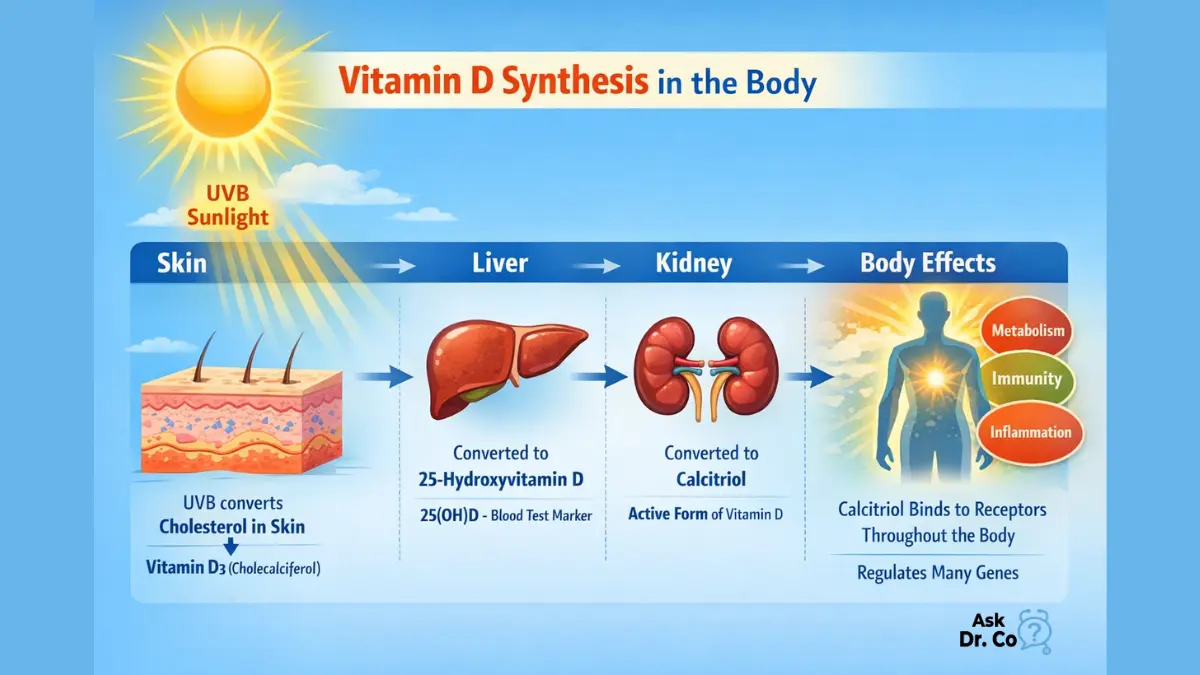
Calcitriol then binds to vitamin D receptors found in nearly every tissue in the body, influencing hundreds of genes involved in metabolism, immunity, and inflammation. [1]
That’s why vitamin D deficiency can have wide-ranging effects.
What Vitamin D Does in the Body
Vitamin D plays several essential roles:
- Helps the body absorb calcium and phosphorus
- Maintains bone strength
- Supports muscle function
- Regulates the immune system
- Reduces inflammation
- Supports cardiovascular health
Vitamin D receptors have been identified in:
- Immune cells
- Blood vessels
- Brain tissue
- Pancreas
- Skeletal muscle
In other words, vitamin D helps regulate many systems that keep the body balanced. When someone is vitamin D deficient, the symptoms can be diverse and subtle, making deficiency easy to miss. [2]
Vitamin D Deficiency Is Extremely Common
Vitamin D deficiency is widespread. Approximately 1 in 3 adults in the United States are deficient, and more than 1 billion people worldwide have low vitamin D levels. This makes vitamin D deficiency a major global public health issue. [2]
Vitamin D and Vascular Health
Vitamin D plays a critical role in maintaining the health of your blood vessels.
It supports the endothelium, the thin inner lining of blood vessels responsible for regulating blood pressure, allowing vessels to relax, and preventing unnecessary inflammation. Vitamin D receptors are present in vascular smooth muscle, endothelium, and cardiomyocytes, which is one reason researchers have been so interested in its cardiovascular effects. [3]
When vitamin D levels fall too low, several pathophysiologic changes can occur:
- Increased inflammation
- Oxidative stress
- Reduced nitric oxide production
- Impaired blood vessel function
Over time, these changes contribute to endothelial dysfunction, an early step in the development of hypertension, atherosclerosis, and cardiovascular disease. [4]
Low vitamin D is also associated with increased inflammatory markers such as IL-6, TNF-alpha, and C-reactive protein, all of which promote vascular inflammation and injury. [4]
In simple terms: when vitamin D is low, blood vessels become less flexible, more inflamed, and more vulnerable to disease.
Should You Be Checking Your Vitamin D Level?
Given how common vitamin D deficiency is—and how significantly it may affect overall health—it is not something to guess about. It is something to measure.
The test your doctor orders is called a 25-hydroxyvitamin D (25(OH)D) level, which reflects your body’s vitamin D stores. [2]
- Deficiency: less than 20 ng/mL
- Insufficiency: 20–29 ng/mL
Because symptoms of low vitamin D may be subtle—or completely absent—many people do not realize they are deficient until it begins affecting their energy, bone health, immune function, or long-term cardiovascular health.
Where Do We Normally Get Vitamin D?
Historically, humans obtained most of their vitamin D from sunlight. Research suggests that a large proportion of vitamin D was originally produced in the skin through sun exposure. Modern lifestyles have changed that dramatically. [2]
Today, many people work indoors, use sunscreen consistently, live in northern latitudes, and spend less time outside. As a result, vitamin D deficiency has become increasingly common.
Natural Sources of Vitamin D
Few foods naturally contain vitamin D.
- Wild salmon
- Sardines
- Cod liver oil
- Egg yolks
- UV-exposed mushrooms
Many foods are fortified, including milk, plant-based milks, cereals, and orange juice.
Even so, diet alone rarely provides enough vitamin D for optimal levels. [2]
What About Sunlight?
Sunlight remains the most natural source.
Short periods of sunlight exposure can produce large amounts of vitamin D. For many people, 5–10 minutes of midday sun exposure on the arms or legs may be sufficient.
However, individuals with fair skin, photosensitivity disorders, or a history of skin cancer should approach UV exposure with caution.
Should You Take a Vitamin D Supplement?
For many adults, the answer is yes.
The most effective form is vitamin D3 (cholecalciferol), the same form produced in the skin. [2]
Many physicians recommend 1,000–2,000 IU daily for most adults, though some individuals may require higher doses depending on blood levels. Supplement needs should be individualized.
When the Body Can’t Activate Vitamin D
Vitamin D deficiency is not always about low intake or lack of sunlight—sometimes the body cannot process it properly.
After vitamin D is produced in the skin or consumed, it must be activated in two steps: [1]
- Liver: converts it to 25-hydroxyvitamin D
- Kidneys: convert it to calcitriol
In chronic kidney disease, the kidneys lose the ability to activate vitamin D. In liver disease, the conversion process is impaired, disrupting the entire pathway. [2] [1]
Other Causes of Vitamin D Deficiency
Chronic Conditions
- Obesity
- Malabsorption disorders
- Chronic liver or kidney disease
- Limited sun exposure
Common Medications
- Steroids
- Antiepileptics
- Orlistat and cholestyramine
- Proton pump inhibitors
Several chronic conditions and medications can interfere with vitamin D levels or metabolism. [2]
Why This Matters: Bone Health and Beyond
Vitamin D is essential for calcium absorption and bone strength. When levels remain low over time, deficiency can lead to:
- Rickets: soft, weak bones in children that can cause skeletal deformities
- Osteomalacia: bone pain and muscle weakness in adults
- Osteoporosis: decreased bone density and increased fracture risk
But the effects extend beyond bones—impacting immunity, inflammation, and cardiovascular health. [2] [4]
The Takeaway
Vitamin D is not just a vitamin for bone health. It is a hormone that influences nearly every system in the body. [1]
Deficiency is common, but it is also often preventable and treatable. Maintaining healthy vitamin D levels through sunlight, diet, and supplementation is an important part of preventative health.
Understanding how your body processes vitamin D—and what conditions may interfere with it—is key to protecting your long-term health.
References
- Norman AW.
From vitamin D to hormone D: fundamentals of the vitamin D endocrine system essential for good health.
American Journal of Clinical Nutrition. 2008;88(2):491S-499S. - Holick MF.
Vitamin D deficiency.
New England Journal of Medicine. 2007;357:266-281. - Wang TJ, Pencina MJ, Booth SL, et al.
Vitamin D deficiency and risk of cardiovascular disease.
Circulation. 2008;117:503-511. - Pilz S, Verheyen N, Grübler MR, Tomaschitz A, März W.
Vitamin D and cardiovascular disease prevention.
Nature Reviews Cardiology. 2016;13:404-417.